#09 – Electro-Optics, Vacuum & Sensor Technology
Precision at temperatures where many materials reach their limits
Insulating and guiding components in electro-optical systems, vacuum equipment and high-end sensor technology have to hold their dimensions while heat, vacuum, radiation and thermal cycling act on them. Machined polyimide components are an established answer to exactly this combination of requirements.

The challenge
Developers of optical systems, thermal imaging equipment and vacuum technology typically specify insulating and guiding components that operate close to lasers and heat sources at 250 to 300 °C. In vacuum environments, the selected grade must demonstrate sufficiently low outgassing for the specified vacuum level, because condensing residues can contaminate lenses and sensor surfaces. Thermal expansion needs to stay low so that optical paths remain aligned. And the parts are needed in small series, machined to tight tolerances, without tooling investment.
Metals typically require additional insulation measures in these positions. Many standard thermoplastics reach their thermal limits. Ceramics are an option, but often costly to machine and sensitive to impact.




The solution
Comco-Polyimide is designed for this profile. The material maintains its mechanical integrity from cryogenic temperatures up to around 300 °C in continuous service, depending on grade and load. The
compression-moulded polyimide grades used for these applications have no conventional melting point. Selected grades show low outgassing, which has made polyimide an established choice in vacuum, semiconductor, aerospace and demanding sensor environments; the suitability for a specific vacuum specification is verified against the required outgassing values. COMCO manufactures these precision components by CNC machining from polyimide stock shapes.
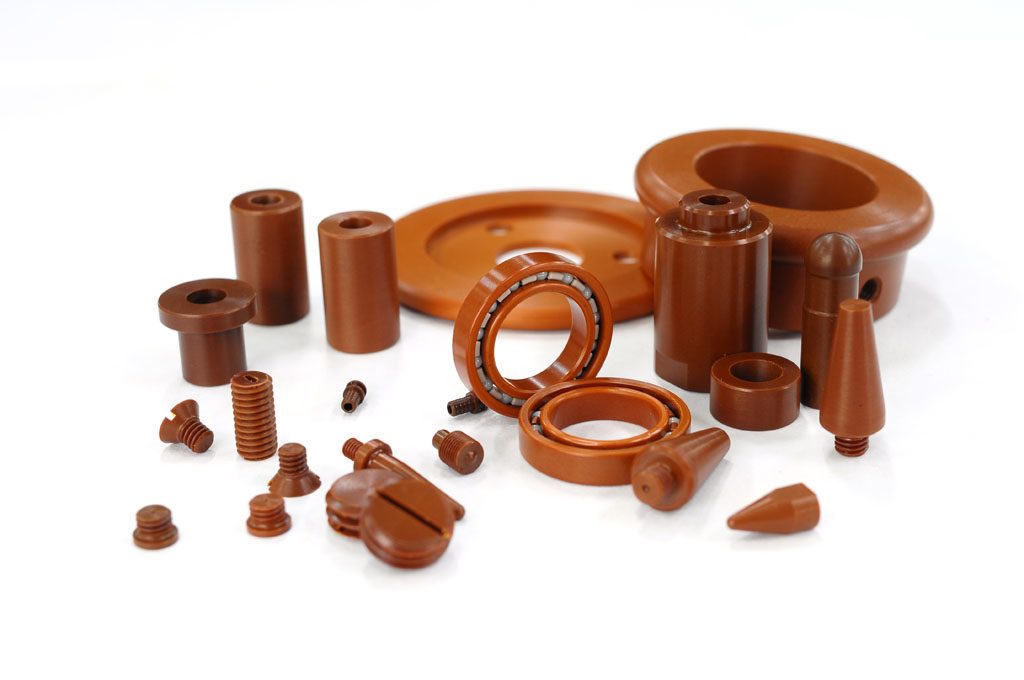
From Comco-Polyimide sheet and rod we machine insulators, spacer rings, mounting elements, valve seats and guide components. Depending on the requirement, we select the suitable grade:
- Comco-Polyimide N, natural dark brown (comparable grades Plavis-N, Vespel® SP-1): unfilled, highest purity, best electrical insulation
- Comco-Polyimide G15 (comparable grades Plavis-G15, Vespel® SP-21): 15 percent graphite,
self-lubricating, for friction and wear applications - Comco-Polyimide G40 (comparable grades Plavis-G40, Vespel® SP-22): 40 percent graphite, lowest thermal expansion, maximum dimensional stability
- Comco-Polyimide MoS (comparable grades Plavis-MS, Vespel® SP-3): 15 percent molybdenum disulphide, for dry-running and vacuum tribology
- Comco-Polyimide ESD (comparable grade Plavis-ESD): electrostatically dissipative with controlled surface resistance for sensitive electronics
For the most demanding sealing and wear applications we additionally offer PLAVIS™ Polyimide as an ultra-high-performance option.
Vespel® is a registered trademark of DuPont.
Products
- Comco-Polyimide semi-finished products and finished parts
- PLAVIS™ Polyimide
“At high temperature in vacuum, the grade selection decides. We verify it against the specification before the first chip is cut.”
Material properties at a glance
- Continuous service temperature up to around 300 °C, depending on grade and load
- Dimensional stability across a wide temperature range
- Low outgassing of selected grades, suitable for vacuum applications after verification
- Inherently flame resistant, high radiation resistance
- Very good electrical insulation of the unfilled grade
- Machinable to tight tolerances from sheet and rod
Warum COMCO EPP
Polyimide components for these requirements are manufactured by machining from stock shapes. That makes material knowledge and machining quality inseparable. As a manufacturer with our own CNC production, we deliver both: the suitable Comco-Polyimide grade for the requirement and the finished precision component, with material certificates on request for critical programmes.
More Case Studies:
#11 – Medical Technology & Reprocessing
Engineered for repeated sterilisation

#10 – PEEK Components for UAV, Aerospace & Defence
Metal replacement where it makes sense
#08 – High-Performance Plastics for Defence & Critical Applications